785-407-9563

About Kansas Pasture Clearing
What Makes Us Different?
Kansas Pasture Clearing focuses on one thing: removing invasive trees and restoring Kansas pastureland efficiently and correctly.

Pasture & Tree Clearing Specialists –
Nothing Else
We specialize exclusively in pasture clearing and tree removal, targeting Eastern Red Cedar removal, Osage Orange (Hedge), Locust, and other invasive trees common to Kansas pastureland.

In-Person Land Assessment & Clear Plan
Every project begins on your property. You set the goals and budget — we create a clear, realistic plan before work starts.

Purpose-Built Forestry Equipment
We operate industrial, commercial-grade forestry equipment designed specifically for tree and brush removal — not general construction or landscaping machines.

Proven Results You Can See
Our work is documented through before-and-after videos and verified Google reviews from Kansas landowners.
Counties We Serve
Cloud County • Clay County • Dickinson County • Lincoln County • Mitchell County • Ottawa County • Pottawatomie County
Riley County • Saline County • Washington County • Morris County (Council Grove area)
We Can Help Save Your Pasture
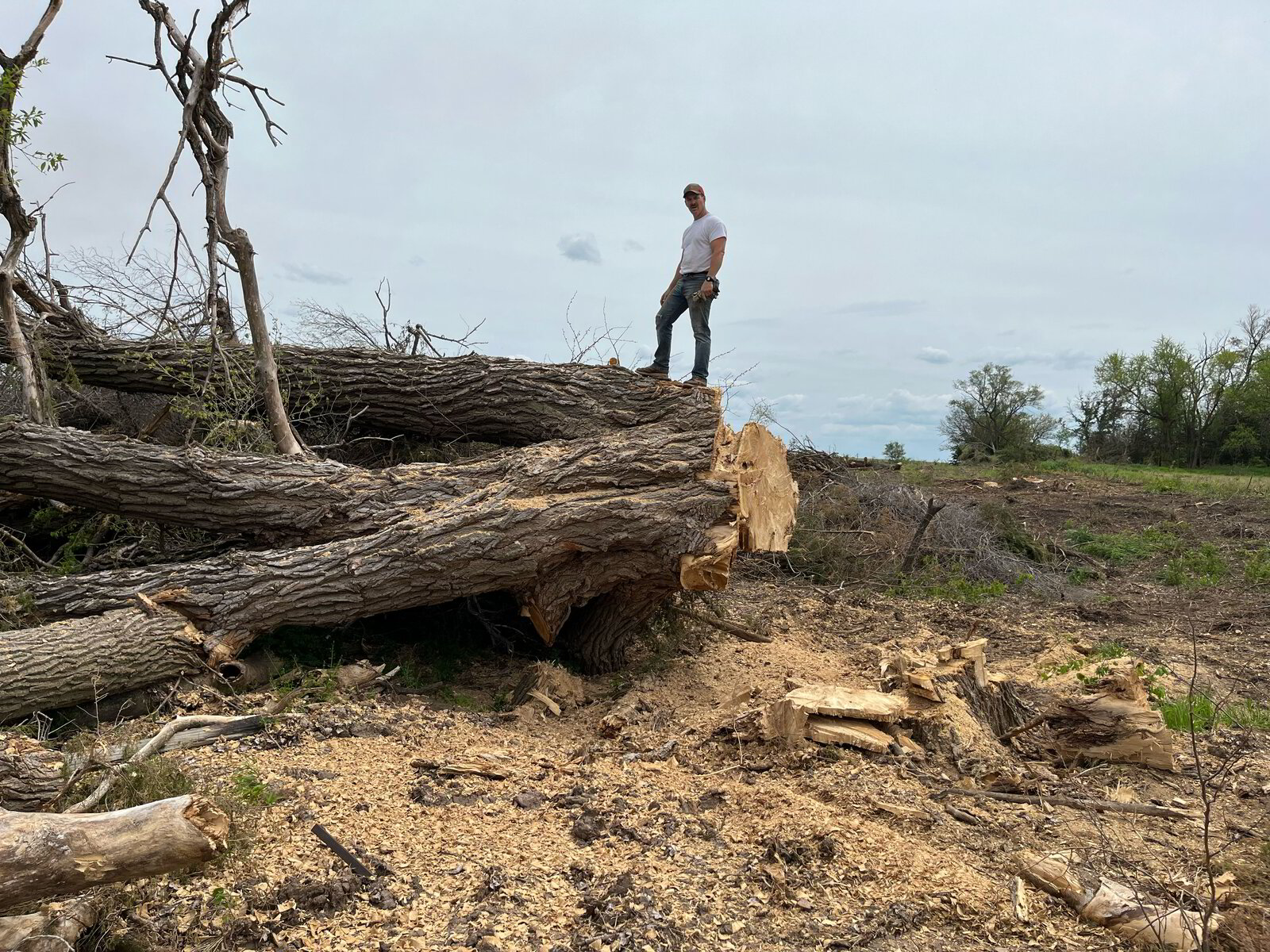
As a fourth generation farmer, I understand value of land and what it means to take back acres from trees. One Eastern Red Cedar tree with a 12 inch stem, can drink 40 gallons of water a day and spread more than a million seeds! Land clearing, forestry mulching, or use of the hydraulic tree saw, in your pasture, waterway, or along your creek, to remove the invasive trees will prepare the land for higher grass or crop production improving your profits.
We can mulch trees into a blanket of nutrient dense ground cover to help grow grass back the next year. We can cut below the surface so you can grow hay and safely cut it the next year. How much are your trees costing you?
Watch Our Machine at Work
Frequently Asked Questions
How Big is the Problem – and What's at Stake If You Wait
This is not a fringe issue — it’s widespread and growing fast.
Across the 10-state Great Plains rangeland region, encroaching woody plants (cedar, locust, elm, hedge species and others) caused the loss of ≈ 22.4 million tons of forage in 2019 alone. Working Lands For Wildlife+1 That’s enough hay to support ~4.7 million cows for a year — lost forever.
Over 30 years, the losses are staggering.
From 1990–2019, the region lost nearly 350 million tons of rangeland production — valued at over $4.5 billion in lost grazing capacity.
For Kansas landowners, the impact is real and measurable.
In 2019 alone, woody encroachment caused a loss of ~1.5 million tons of grazing production in Kansas — forage that could have supported hundreds or thousands of cows.
Dense tree invasion can reduce pasture productivity by up to 75%.
Where trees become established, native grasses and forage species are shaded out, water is diverted, and growth is cut drastically.
Once seed-producing trees are established, the problem compounds quickly.
A single mature cedar can produce hundreds of thousands to millions of seeds per year. Left unchecked, these seed sources quickly “contaminate” adjacent grasslands, meaning the issue spreads even if only a few trees exist now.
The cost of inaction increases rapidly over time.
Delaying clearing while trees mature—or worse, letting them seed—means that follow-up efforts become far more expensive, required more often, and often ineffective unless repeated.
What This Means for You – Why You Should Act Now
Every acre you don’t manage becomes a seed source. That means even if you clear once and stop, adjacent cedar, elm, hedge, locust or other “escaped” trees can reseed your pasture. The longer you wait, the more pasture value and forage production you lose — permanently. Hay that should support cattle or generate ranch income ends up in tree roots instead.
Costs go up exponentially: A few small trees today may be manageable; large seed-bearing stands tomorrow can cost far more to remove and often require repeated treatments.
Clearing now is not just about “getting rid of ugly trees.” It’s about protecting assets — your pasture productivity, livestock potential, and long-term value of your land.
Key Sources for These Claims
- Working Lands for Wildlife & University of Nebraska–Lincoln — Rangeland production lost to woody encroachment in Great Plains grasslands (2019 data) ksfire.org+1
- Nebraska Extension — More than 419,000 Tons of Rangeland Production are Lost Annually in Nebraska to Woody Encroachment (2023) — demonstrates state-level losses and that 1990–2019 encroachment increased tree cover by >400,000 acres there. UNL Beef+1
- USDA Natural Resources Conservation Service (NRCS) and rangeland science guides — outline reductions in forage production up to 75% under heavy woody invasion and explain the mechanics of seed-source risk and need for follow-up treatment. Nebraska Extension Publications+1
What is Woody Encroachment?
It's the gradual conversion of grassland to woody-dominated landscapes, changing ecosystem structure and function. Key threats include Eastern Redcedar, which spreads via bird-dispersed seeds, creating dense stands that reduce grass production and habitat.
GPGI (Great Plains Grassland Initiative) woody encroachment refers to the collaborative effort, led by ranchers and supported by science, to combat the expansion of trees and shrubs (like Eastern Redcedar) into historically treeless Great Plains grasslands, which threatens livestock, wildlife, water, and fire resilience, using strategies like "defend the core" to protect intact areas and "grow the core" by removing woody plants and managing the seedbank.
The GPGI Approach
Rancher-Driven & Science-Based: Producers lead efforts with technical guidance from agencies like the NRCS (Natural Resources Conservation Service).
"Defend the Core, Grow the Core": Focuses on protecting existing open grasslands (core areas) and expanding them by removing encroaching woody plants.
Integrated Management: Uses prescribed fire, mechanical clearing, and chemical treatments to control mature trees and prevent seedling establishment.
Collaboration: Works across property lines to create large, continuous grassland corridors.
Why It Matters
Reduces carrying capacity for livestock.
Increases wildfire risk and intensity.
Leads to biodiversity loss.
Impacts water resources.
How to Get Involved
Contact your local USDA Service Center for technical and financial assistance through programs like Working Lands for Wildlife (WLFW).
Resource Links
https://farmflavor.com/kansas/the-great-plains-grassland-initiative-protects-kansas-grasslands/
https://www.wlfw.org/defend-the-core-fighting-back-against-woody-invaders-on-the-great-plains/
How Eastern Redcedar Encroachment Affects the Water Cycle of Oklahoma Rangelands
Published by the OSU Extension Office
The rapidly increasing acreage encroached by eastern redcedar (Juniperus virginiana) has recently attracted the attention of land owners, natural resource managers, water managers and policy makers because of the potential effect on streamflow and water supply. Numerous estimates of the amount of water used by redcedar trees have appeared in the media and other sources. From these numbers, streamflow reduction by redcedar encroachment or increases in streamflow following redcedar removal have been projected. However, simple extrapolations ignore the complex interactions among processes in the water budget and differences in watershed topography, geology, climate and soils that exist across Oklahoma. This fact sheet provides basic concepts about the linkages among climate, vegetation, and hydrological processes necessary to understand and evaluate the potential of redcedar encroachment to influence the water budget on Oklahoma rangelands.
Both redcedar and Ashe juniper (J. ashei) are present in Oklahoma rangeland. Because both species have similar canopy structure and other biological characteristics, we will focus on redcedar for simplicity.
Resource Link
https://conservation.ok.gov/wp-content/uploads/2021/07/Eastern-Redcedar-Invading-the-Landscape.pdf
Contact Us
Type of Job

Counties We Serve
Cloud County
Clay County
Dickinson County
Lincoln County
Mitchell County
Ottawa County
Pottawatomie County
Riley County
Saline County
Washington County
Morris County (Council Grove area)
Call Today
785-407-9563
© 2026 Kansas Pasture Clearing. All Rights reserved.